Monograph · Tree · ← Module hub · PBR metallic-roughness
materials
PBR metallic-roughness
F0, ORM convention, roughness floors.
The lie artists can paint
The physically-correct microfacet BRDF wants a spectral, complex index of refraction at every surface point. No artist authors that. OHAO collapses it to three scalars an artist can paint into textures — base color, metallic, roughness — and reconstructs the physics at shade time. This page is about what that reconstruction gets right, and the one thing about OHAO that surprises people: it reconstructs the *same three sliders* twice, on two different BRDF stacks that do not agree.
F0: the 0.04 that is not arbitrary
F0 is the Fresnel reflectance at normal incidence — the fraction of light a flat surface bounces straight back when you look at it head-on. For a dielectric it is fixed by the index of refraction n through F0 = ((n - 1)/(n + 1))^2. Common dielectrics sit near n = 1.5, so:
Metals have no meaningful single-scalar IOR in this model and absorb all transmitted light within nanometers, so they get zero diffuse and reuse base color as F0. Both pipelines collapse the two cases into one branch-free `mix`; in the path tracer it sits in the raygen shading loop, just after the hit is unpacked:
vec3 F0 = mix(vec3(0.04), albedo, metallic);shaders/rt/pt_raygen.rgen:276The intermediate values of that lerp (metallic = 0.5) are not physical — no real material is half-conductor. The path tracer keeps the slider continuous anyway, because a continuous, monotonic control is all an artist needs and the pure 0/1 endpoints are exactly right. The deferred pipeline makes the opposite call — see below — which is the first place the two stacks diverge.
One reduction, two BRDFs
Here is the fact that governs everything else on this page. OHAO's path-tracer and its deferred rasteriser do not share a BRDF file. The path-tracer raygen shaders include `ggx_aniso.glsl`:
float ggxD_anisoOrIso(vec3 N, vec3 H, float NdotH, float roughness,shaders/includes/material/ggx_aniso.glsl:31while the deferred and forward fragment shaders call `evaluateBRDF` in `brdf_ggx.glsl`. They agree on F0 and on being "GGX metallic-roughness," and they diverge on almost everything expensive: the geometry term, energy compensation, diffuse model, and even how the metallic slider is interpreted. The rest of this page walks each stack, then the gap between them.
The path tracer's specular
The default offline `PathTracer` binds `pt_raygen.rgen` (the shaders behind `cornell_box`, `model_viewer`, `env_demo`, `turntable`). Its direct lighting is next-event estimation: for each light sample it evaluates analytic Cook-Torrance inline — the anisotropy-aware GGX D, a Schlick Fresnel, a Smith-Schlick geometry term using the `(roughness + 1)^2 / 8` direct-lighting k remap, then a plain Lambert diffuse (not Burley):
vec3 diff = kD * albedo / 3.14159;shaders/rt/pt_raygen.rgen:411The D term is anisotropy-aware; at anisotropy = 0 it falls back to the exact isotropic GGX so older reference renders stay bit-identical. The anisotropy direction is not read from a tangent attribute — it is reconstructed by projecting world-up onto the surface:
t = normalize(ref - n * dot(ref, n));shaders/includes/material/ggx_aniso.glsl:27That detail matters more than it looks: Frisvad's cheaper basis varies discontinuously with the normal, so on a sphere neighbouring pixels get scrambled tangents and the anisotropic highlight averages back into something that looks isotropic. Projecting a fixed world axis gives a smoothly-varying tangent (a lathe-turned look on spheres), which is the whole point of shipping anisotropy.
Indirect bounces in the offline path are *not* VNDF-importance-sampled — they use a cosine-weighted hemisphere sample narrowed by roughness, i.e. a roughness-widened reflection lobe:
vec3 jitVec = cosineHemisphere(reflected, jitU) * roughness;shaders/rt/pt_raygen.rgen:519The realtime RT profile (`pt_raygen_realtime.rgen`, the `--denoise=nrd`/DLSS path) is the one that upgrades the indirect glossy bounce to Heitz-2018 sampling of the *visible* normal distribution:
vec3 Hloc = sampleGGXVNDF(Vloc, alpha, alpha, u);shaders/rt/pt_raygen_realtime.rgen:774With a VNDF sample the Monte-Carlo estimator weight `f·cosθ / pdf` collapses to a single height-correlated Smith ratio once Fresnel is factored out —
— so that branch returns exactly `F · G2/G1` instead of forming D and the pdf separately:
specThroughput = F * smithG2overG1GGX(NdotV, NdotL, alpha);shaders/rt/pt_raygen_realtime.rgen:792So VNDF sampling is a realtime-profile feature, not a property of the flagship offline tracer — a distinction worth keeping straight when reading the raygen family.
The deferred pipeline's specular
The rasteriser cannot importance-sample per pixel, so `brdf_ggx.glsl` evaluates the full analytic Cook-Torrance and spends the saved rays on quality. Its geometry term is the height-correlated Smith form (Heitz 2014) — which, unlike the path tracer's NEE term, needs no k remap at all:
float geometrySmithCorrelated(float NdotV, float NdotL, float roughness) {shaders/includes/brdf/brdf_ggx.glsl:66Then — the part most hobby renderers omit — it adds back the energy single-scatter GGX loses at high roughness (Kulla-Conty 2017 / Turquin 2019). Single-scatter models exactly one bounce off the microsurface, so rough metal comes out visibly too dark; the compensation term redistributes the lost energy:
where E is the directional albedo of single-scatter GGX, taken from a polynomial fit rather than a lookup table:
float Ems = (1.0 - E_o) * (1.0 - E_i); // energy lost by single scattershaders/includes/brdf/brdf_ggx.glsl:159vec3 Favg = surface.F0 + (1.0 - surface.F0) / 21.0; // average Fresnelshaders/includes/brdf/brdf_ggx.glsl:160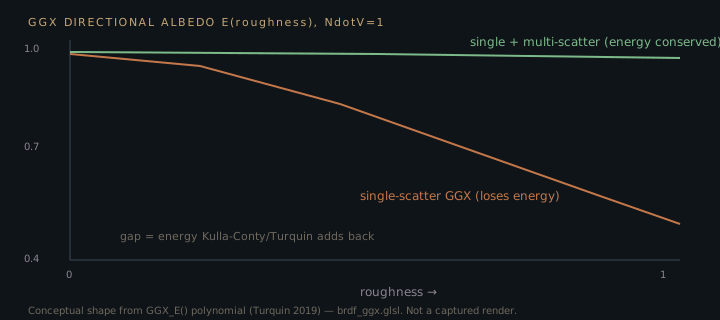
The deferred stack also reinterprets the metallic slider itself. Where the path tracer keeps it continuous, the deferred surface setup sharpens it toward the pure endpoints before computing F0:
float sharpenedMetallic = smoothstep(0.35, 0.65, metallic);shaders/includes/brdf/brdf_common.glsl:44so a painted metallic of 0.5 reads as a cleaner dielectric-or-metal decision under raster lighting — cheaper to make look right, at the cost of the smooth half-metal ramp the path tracer preserves.
Where the two paths disagree
Because multi-scatter compensation lives only in `brdf_ggx.glsl`, and the offline path tracer runs `ggx_aniso.glsl` with no such term, a rough metal is energy-compensated in the deferred viewport but single-scatter-dark in the final path-traced frame. Look-dev done against the fast deferred preview will therefore *under*-brighten rough metals for the offline render. This is a real portability gap, not a matched pair — closing it means porting the Kulla-Conty term into the raygen, not pretending it is already there.
The k-remaps, and where each one lives
A Smith-Schlick geometry approximation needs a roughness remap, and engine docs love to get this wrong, so here is the honest map for OHAO. There are three distinct geometry treatments in the tree:
- **Path-tracer NEE direct light** uses the classic `(roughness + 1)^2 / 8`
direct-lighting remap, inlined in the analytic Cook-Torrance block cited above (`pt_raygen.rgen`, repeated once per NEE branch across all three raygen variants). This is the shipping direct-light geometry term — very much alive.
- **Path-tracer realtime VNDF indirect** uses height-correlated Smith
(`smithG2overG1GGX`), which needs no remap.
- **Deferred image-based lighting** precomputes the split-sum BRDF integral with a
*different* remap, `(a*a)/2`, into a LUT that the deferred lighting pass samples:
float k = (a * a) / 2.0;shaders/compute/brdf_lut.comp:51The only thing that is genuinely dead here is the *named* `geometrySchlickGGX` function in `brdf_ggx.glsl` (no callers); the identical `(r+1)^2/8` math it contains still ships, inlined, as the path tracer's NEE geometry term. "Function unused" and "formula unused" are not the same claim, and only the first is true.
Where the packed roughness comes from
At the closest-hit shader the material arrives packed into a payload vector, and the unpack carries a backward-compatibility story worth knowing before you touch it. The current encoding is continuous roughness in `.x`, metallic in `.y`:
if (att.x < 0.0 && att.y < 1e-4) {shaders/includes/pbr_unpack.glsl:9A legacy signed encoding (negative `.x` meant "binary metal") is still accepted when `.y` is ~0, so old shader-binding-table payloads authored mid-session do not silently break. Removing that branch is safe only once every producer writes the new form.
Contracts
- Both stacks derive F0 = mix(0.04, albedo, metallic) — but the deferred path first sharpens metallic via `smoothstep(0.35, 0.65)`, so the F0 they feed differs at mid-slider values. Metals get zero diffuse; dielectrics F0 = 0.04.
- Roughness is clamped away from 0 (`max(roughness, 0.01)` in the unpack) so the specular lobe never becomes a zero-width delta that fireflies in the path tracer.
- The offline path tracer (`ggx_aniso.glsl`) and deferred pipeline (`brdf_ggx.glsl`) are NOT energy-matched at high roughness: multi-scatter compensation is deferred-only. Treat the deferred preview as an approximation of the offline result for rough metals, not ground truth.
- VNDF specular importance sampling is specific to the realtime RT profile (`pt_raygen_realtime.rgen`); the default offline tracer uses analytic NEE plus cosine-jittered indirect bounces.
Source files
shaders/rt/pt_raygen.rgenshaders/includes/material/ggx_aniso.glslshaders/rt/pt_raygen_realtime.rgenshaders/includes/brdf/brdf_ggx.glslshaders/includes/brdf/brdf_common.glslshaders/compute/brdf_lut.compshaders/includes/pbr_unpack.glslParent hub for the full pipeline narrative; this page is the file-level design unit. Sitemap · hover glossary terms anywhere.