
Abstract
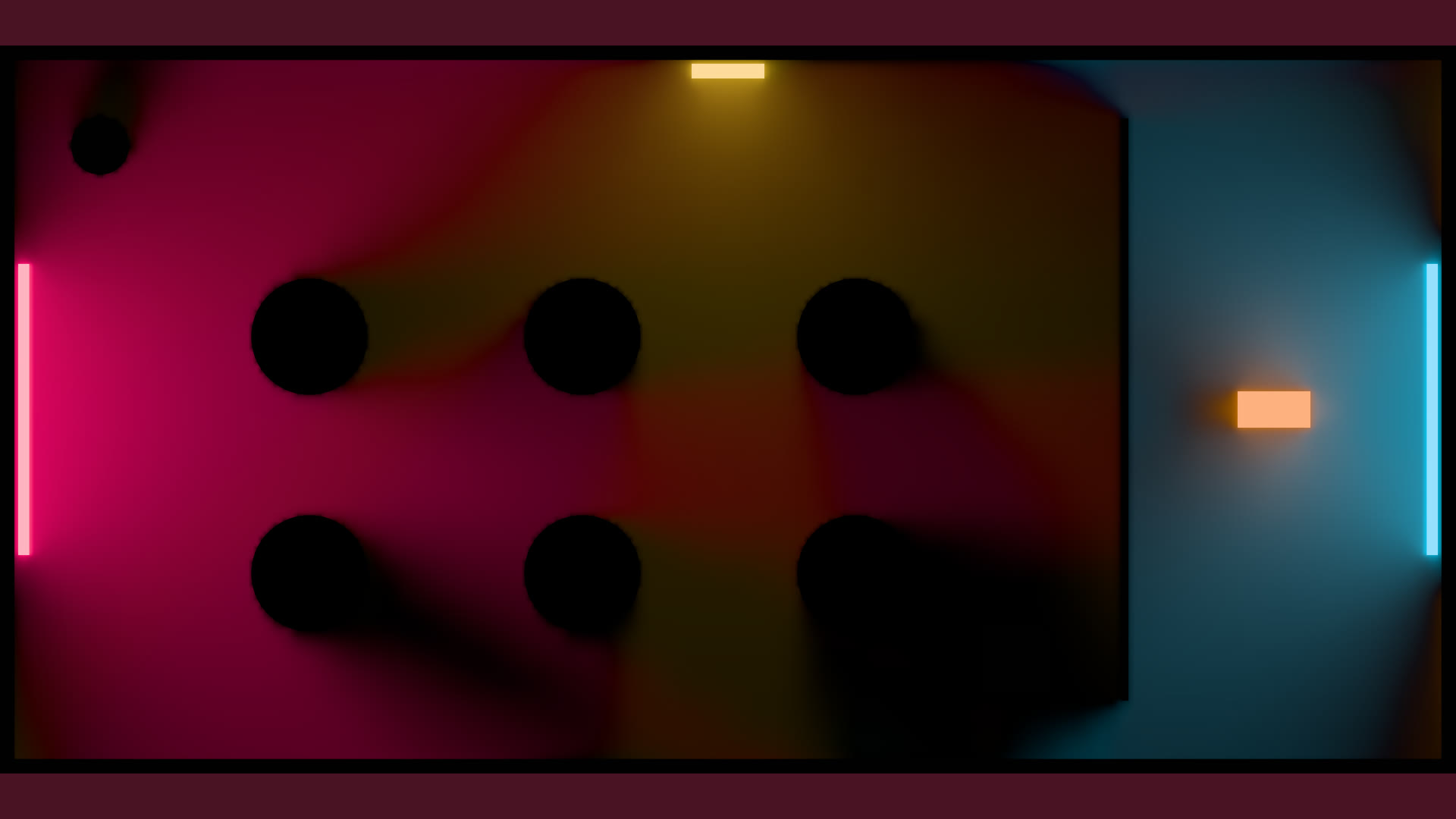
The video now uses live simulated footage: the same C++ cascade renderer re-lights the laundromat every frame while a neon tube flickers, a drum rolls down the aisle and a lamp slides along the wall, with optional overlays of each layer's probe grid and ray intervals as the layers build up and merge. (Simulated offline on the CPU at roughly a quarter second per frame; not real-time.)
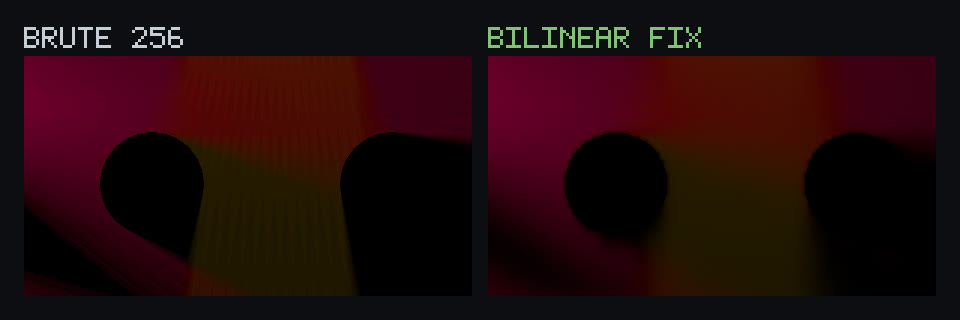
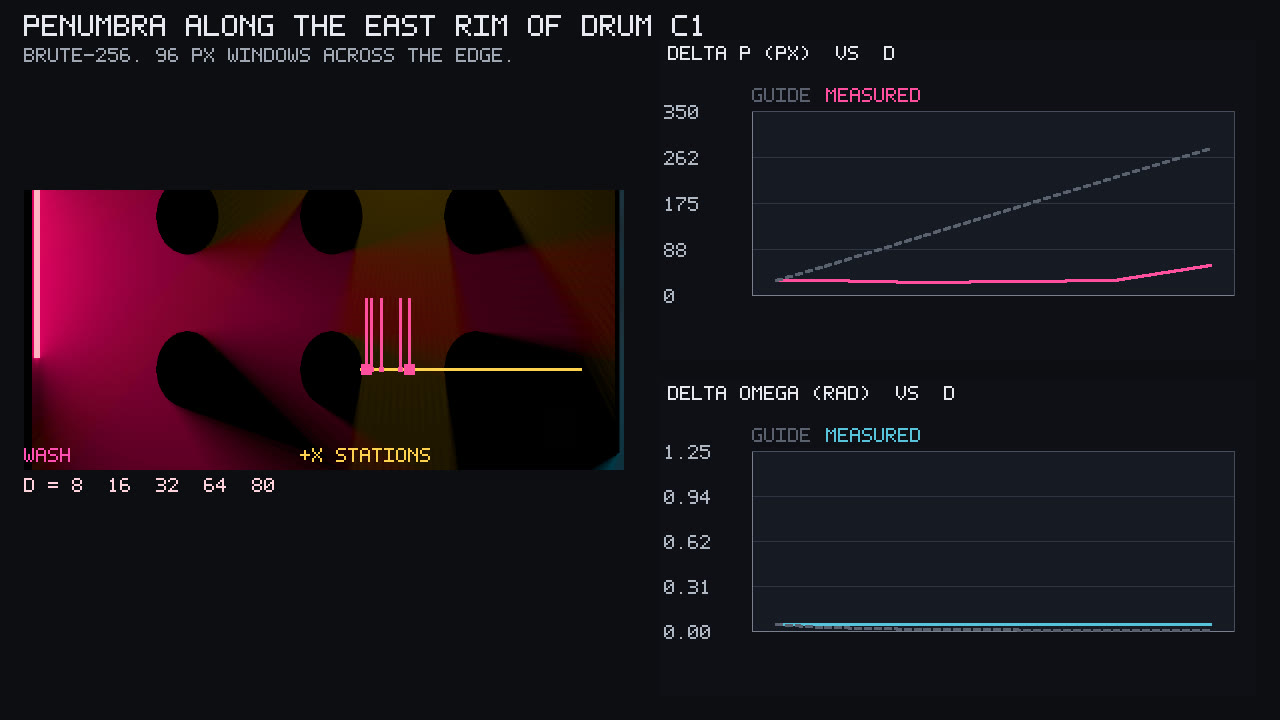
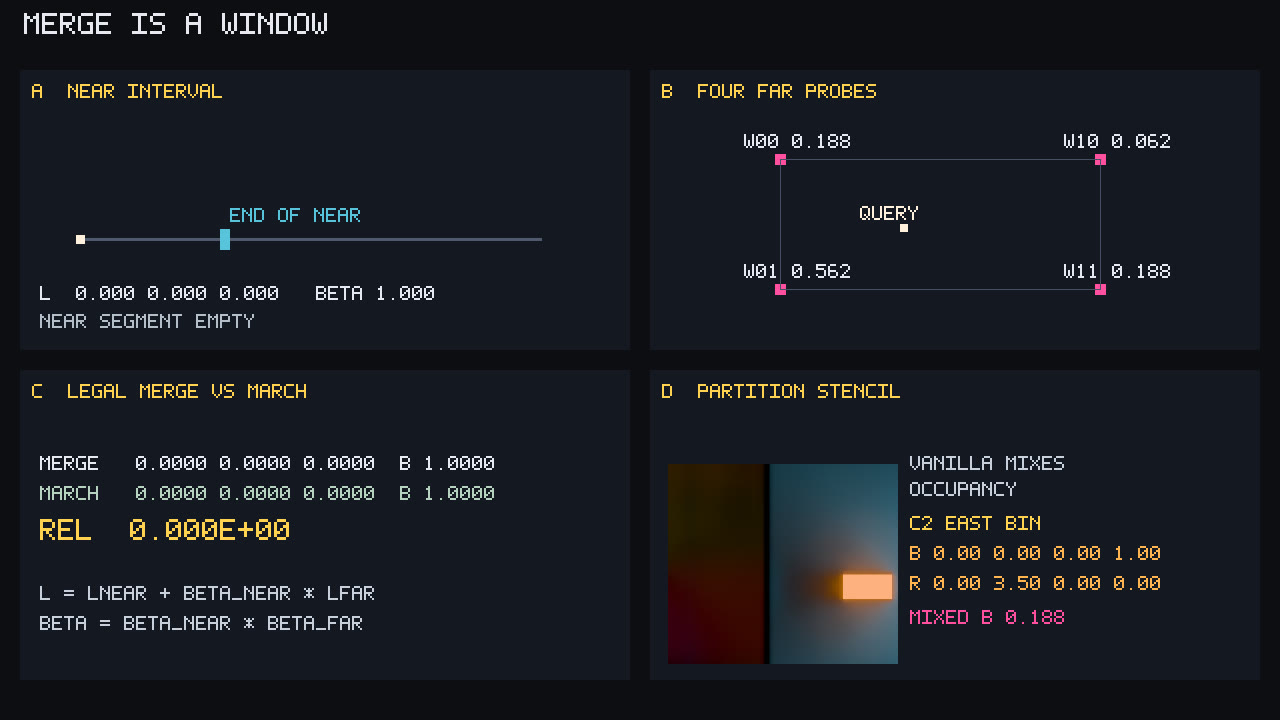
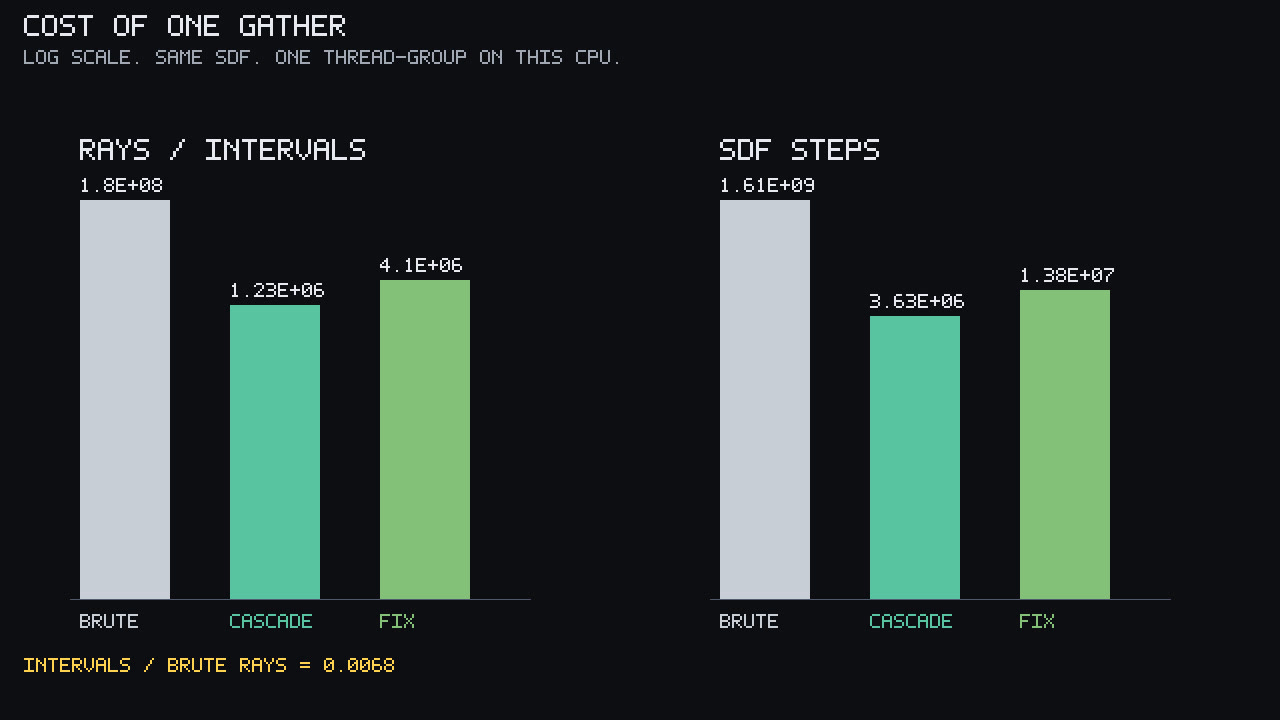
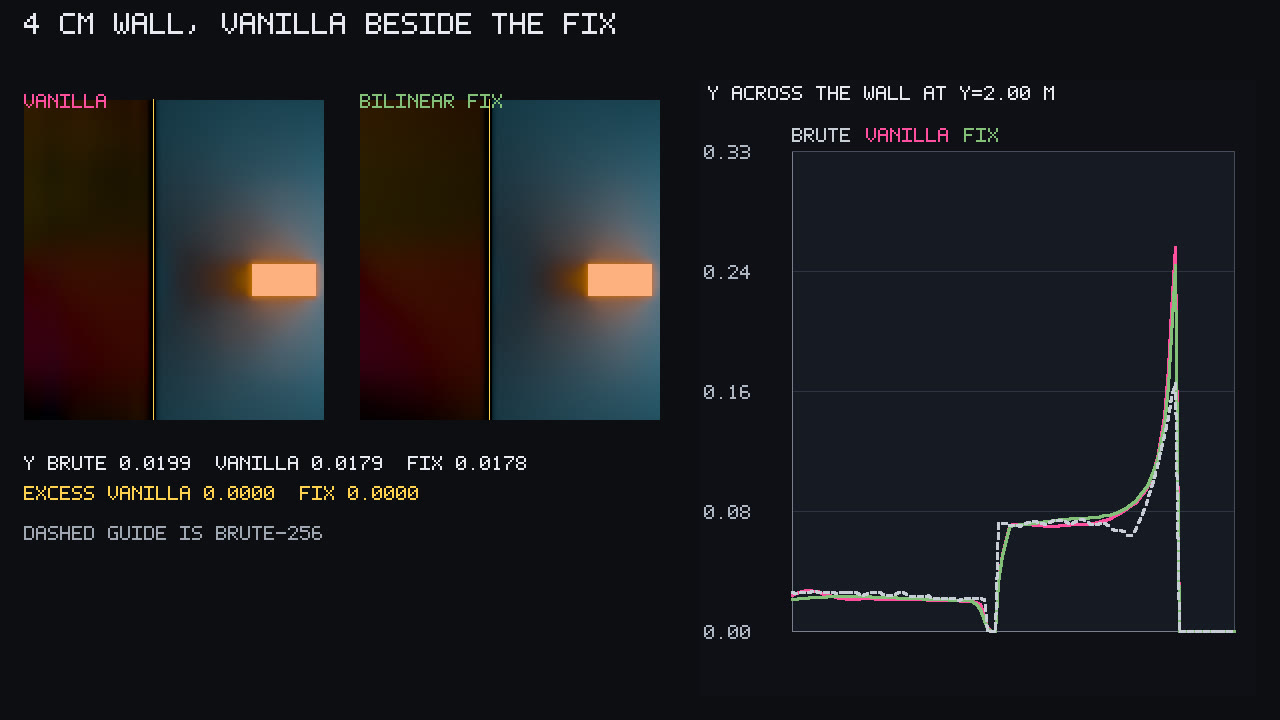
An all-night coin laundry seen from above, lit only by neon tubes. Washer drums cast shadows that are sharp right at the drum and soft further down the aisle. That is a spatial-versus-angular tradeoff: near an occluder you need fine spacing between probes but few directions; far away, coarse spacing but many directions. Radiance cascades store exactly that as a stack of shells, each with twice the probe spacing and four times the rays, so every shell costs the same ( probe-rays here). Near and far intervals merge through transmittance, : merging is looking through a window. The six cascades march as many rays as a 256-ray reference. This run is honest about what did not work: 8 of 12 gates pass. Bilinear-fix misses the reference by a relative error of (target ), the angular half of the penumbra test stays flat (128 rays at every station, because the whole room's neon sets the angular detail), and the thin partition never leaked, so there was no leak for the fix to beat.
Key figures
References
- A. Sannikov. Radiance Cascades: A Novel Approach to Calculating Global Illumination (WIP preprint), 2023.
- A. Sannikov. Rendering Path of Exile 2, ExileCon 2023.
- C. M. J. Osborne, A. Sannikov. Radiance Cascades: A Novel High-Resolution Formal Solution for Multidimensional Non-LTE Radiative Transfer. arXiv:2408.14425, 2024.